CHECK THE WHOLE MESSAGE
Send a song to a friend with clear intent
Name the friendly reason you are sharing, then check whether the recording and your sign-off support that reason. If the song still feels like a romantic declaration, choose another track. A clear note can explain your intention, but it cannot guarantee how your friend will interpret it.
Make a music card →Read three parts together
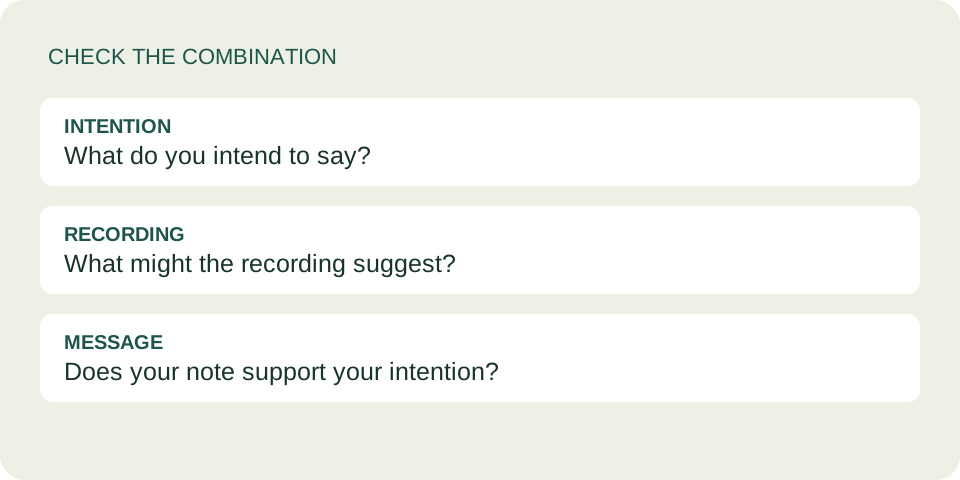
Try this exercise before creating a card. Write three short lines on paper: what you want to say, what someone could reasonably hear in the song, and what your message actually says. If the lines point in different directions, edit the combination rather than adding a long disclaimer.
Intention: I found a recording my friend might enjoy.
Music: A performance that sounds like a declaration of exclusive love.
Note: “Nothing else could explain how I feel.”
This is an invented practice case, not a real person's message. Its problem is the mismatch: casual music discovery is the intention, but both the song and the note suggest a much bigger statement. Calling it “just a song” afterward does not remove that ambiguity.
Two ways to repair a mixed signal
Keep the track when the musical detail is the reason
Suppose your friend plays bass and you genuinely want to share an interesting bass part. An invented note might be: “Listen to the bass entrance in this performance. It made me think of the sound you were experimenting with.” This explains the musical reason without asking the lyrics to speak for you. Use that detail only if it is true.
Still listen to the whole recording yourself. If the dedication format would make this particular selection awkward, a straightforward conversation about the performance may be more suitable than a personal card.
Keep the friendly gesture and change the track
Suppose the goal is simply to brighten a friend's afternoon, with no attachment to a particular recording. Choose music they might enjoy that does not conflict with that purpose. An invented note could read: “A small soundtrack for your drawing break. I thought you would like the percussion.” There is no need to manufacture a shared memory or promise that this song represents your entire friendship.
These alternatives solve different problems. The first explains a specific reason for a specific recording. The second changes the recording because the gesture matters more than the track. Neither is a script that guarantees a response.
Check the signature as well as the note
Open the finished card and read its recipient, message and signature in one pass. A friendly explanation can become harder to interpret if the sender is unknown. If identifying yourself fits the situation, keep your name visible. Do not use anonymity to test whether someone has feelings for you.
On this site, the anonymous option changes the card signature; it does not promise that the channel used to send the link hides your identity. See the anonymity guide for that separate limitation.
Questions about friendly song sharing
Can an instrumental track remove all ambiguity?
No. Removing lyrics removes one source of meaning, but the title, occasion and accompanying note still provide context. Explain your real reason instead of treating any genre as automatically safe.
Should I write “this is not romantic”?
If there is a real misunderstanding to address, be direct. For an ordinary recommendation, a concrete reason such as enjoying the rhythm may communicate more naturally than an unsolicited denial. Choose wording that fits your actual conversation.
What if the friend reads it differently anyway?
Clarify what you meant in your own words and accept their reaction. Do not insist that your explanation obliges them to be comfortable, and do not send more cards to force a different response.
Is this the same as writing a thank-you?
No. A thank-you explains what someone did for you; this check looks for conflicts between your intended gesture and the complete card. If appreciation is your purpose, use the thank-you editing exercise, then return to this final check.
Receiving a song is a different choice