MUSIC WITHOUT LYRICS
Dedicate instrumental music without inventing a meaning
Choose the recording you mean, then explain your own connection in plain words. You do not need lyrics to send a song with a message. Describe something you actually noticed, connect it to a real memory or thought, and avoid claiming the composer or recipient shares your interpretation.
Use an observation, not a hidden translation
Instrumental music can accompany a personal note without standing in for one. A rising melody is not a coded promise; a quiet passage does not prove that someone feels peaceful. This writing exercise separates what you heard from the story you bring to it.
What I noticed
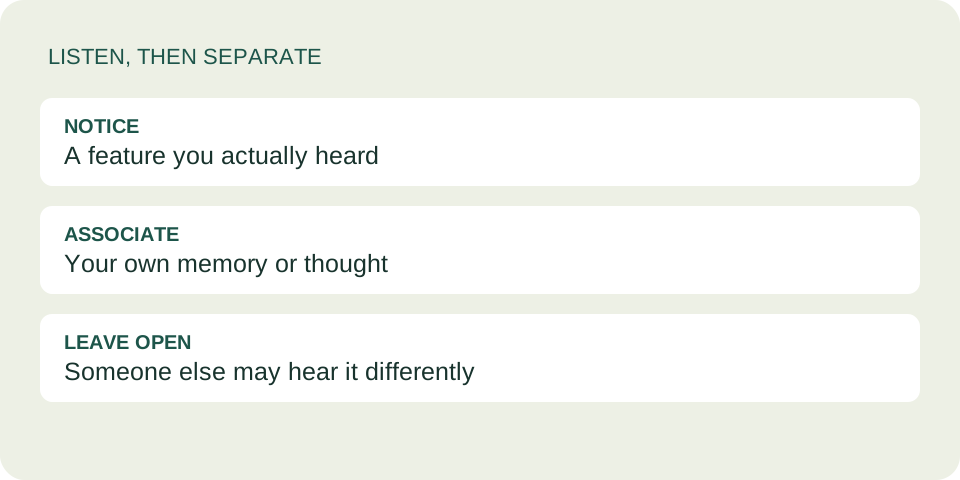
Describe a feature you can locate: a repeating phrase, a change in volume, a pause, or an ending. If you cannot identify the instrument, describe its sound instead of confidently naming it.
What it brought to mind
Use first-person language for your association. “It reminded me of our walk” describes your experience. “This is what our walk meant to you” makes a claim about someone else.
What I cannot establish
Leave the composer's intention, another listener's feelings and the recipient's future reaction unknown unless you have a reliable basis. You do not need those claims to write a thoughtful card.
Revise a fictional instrumental dedication
The following exercise invents a listening situation. It does not describe an existing recording or a real person's message.
“This piece tells the story of our evening by the window. The composer knew exactly how we felt, and you will find it relaxing.”
Three claims need attention. The story belongs to the writer, the composer's knowledge is unsupported, and relaxation is predicted for the recipient. Keep the personal connection while removing those claims:
“The short phrase that comes back near the end made me think of the evening we spent watching the rain from your window. I liked being there with you. Sharing this because it brought that memory back for me.”
Before using this pattern, replace both the musical observation and the memory with something true. If you did not notice a repeated phrase, do not add one just to sound specific. “I heard this today and thought of you” is more honest than a detailed description you cannot support.
Read the revised note without playing the track. The appreciation should still be clear. The music adds an association; it does not require the recipient to solve a puzzle before understanding your words.
Distinguish a piece from a particular recording
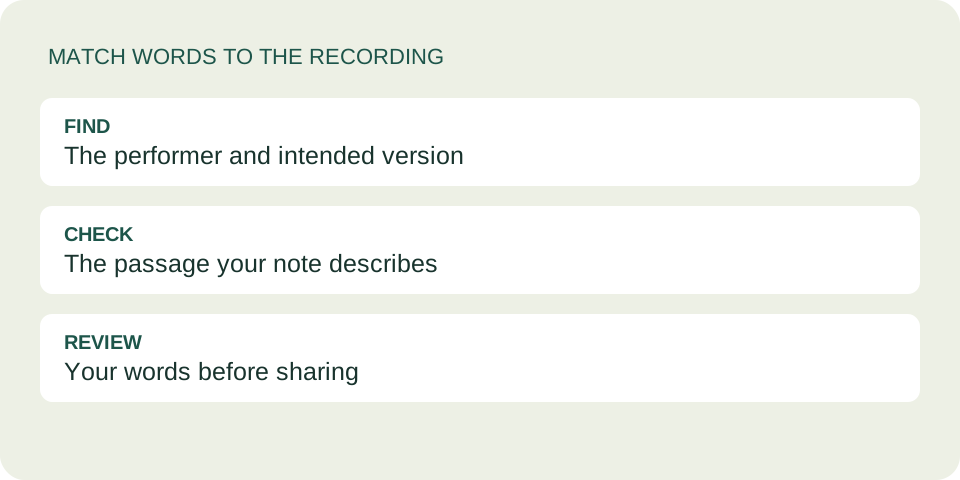
Two recordings with the same composition title can sound different. If your note refers to a quiet ending, a solo performance or a particular passage, check the recording attached to the card rather than relying on the title alone.
- Keep the performer and any version information with the title while you search.
- Open the music-service result and check that it is the recording you listened to.
- Review the feature mentioned in your note. If the version differs, choose the intended recording or rewrite the observation.
- Use a complete supported Spotify track link or a result from the tool's music search. Instrumental music does not require a special card mode.
A card preview is not proof that playback works for every listener. The cross-service recording guide covers matching versions when your recipient uses another app.
Make the invitation specific and optional
If you want to point out a moment, write “I noticed the pause before the ending” rather than promising a feeling. A timestamp can help someone locate a passage, but only include one you checked on that recording. Do not suggest that the card automatically starts there: the tool has no passage-selection control.
Let the person choose whether and when to listen. Avoid presenting the track as a treatment, a guaranteed mood change, or an instruction to feel better. You can say why you wanted to share it without assigning it a job in someone else's day.
Questions about instrumental dedications
Do I need technical music vocabulary?
No. A clear description of something you heard is enough. If you are unsure whether the sound is a particular instrument, avoid guessing its name.
Can I dedicate a soundtrack?
You can share a supported recording link. Explain your own connection, especially if the recipient may not know the film or game. Do not assume they share its story or associate it with the same scene.
Should I explain what the composer meant?
That is not necessary for a personal dedication. Without a reliable source, describe your interpretation as yours. A personal association is not a factual account of the work's origin.
What if they hear something different?
Your note can leave that possibility open. You are sharing an experience, not testing whether the other person reaches the same interpretation.